
Yesterday, Brian Balfour, founder of Viximo, posted a great article pointing to lessons that the virtual goods industry can learn from Starbucks. In many ways, coffee from Starbucks is like a virtual good whose value is determined by intangible factors such as branding, premium positioning, and affordable luxury. As a result, Starbucks is a great model for how to sell virtual goods. Brian digs into how Starbucks maximizes revenue during the holidays through holiday-focused product, strong social context, and savvy management of pricing and promotions — all strategies that are directly applicable to selling virtual goods.

Near perfect price discrimination has been touted as one of the major advantages of virtual goods as a business model. Intrinsically, virtual goods provide a form of first degree price discrimination where users with a higher willingness-to-pay consume greater quantities of virtual goods. This means that site and game operators can capture a higher share of the value delivered to their end users and achieve a higher overall ARPU (average revenue per user).

While first degree price discrimination is a well understood topic in the virtual goods industry, there is another form of price discrimination that can be just as powerful — third degree price discrimination, better known as dynamic pricing. Dynamic pricing involves changing prices based on moment-to-moment or user-by-user changes in demand.

I’m really excited to present “Show Me the Money: Maximizing Virtual Goods through Dynamic Pricing”, a guest article written by Rex Fisher, VP of Business Development at Digonex Technologies. Digonex is a pioneer in the field of dynamic pricing and have helped companies in digital media, event ticketing, retail, and manufacturing improve their profitability through dynamic pricing.

Show Me the Money: Maximizing Virtual Goods through Dynamic Pricing

It’s no secret that the virtual goods industry has exploded in the past two years. The growing popularity and sales of in-game items, including avatar customization and virtual gifts such as pets and coins, has industry analysts predicting the market will top one billion dollars in 2009 alone in the US and nearly seven billion in China. The specific marketplace as a whole is a huge economic opportunity just for in-game items.

What many may not know is virtual goods represent the next big opportunity for large companies, mainstream brands and social networking platforms who are struggling to meet revenue goals in a difficult advertising climate.

So how can organizations maximize this market opportunity to offer users meaningful ways to emotionally interact with friends, family, colleagues, etc. online, while keeping their target audiences engaged with their products and services, and dramatically impacting their bottom line? The answer lies in dynamic pricing.

This article will outline the features and benefits of dynamic pricing and illustrate how modern pricing structures can help organizations such as casual multiplayer online games (MMOs) and virtual world developers implement sound pricing strategies, maximize revenue opportunities and significantly drive the future of the virtual goods industry.

Dynamic Pricing: A Primer

Dynamic pricing is critical to maximizing profits and growth in the virtual goods industry. While sophisticated pricing models are still a relatively new concept, the impact that dynamic pricing can have on selling and purchasing behaviors is significant. Dynamic pricing is already becoming prevalent in many industries including manufacturing, event ticketing and digital media (i.e. downloadable music). Let’s take a look at closer look at the basic principles of dynamic pricing.

Consider your last fill up at a gas station. We all know that gas prices typically jump on Friday and fall on Monday in response to demand. Do weekend gas prices keep some people from buying gas? Absolutely – just not enough people to affect pricing. Of course, demand for gasoline is relatively inelastic. It is not always the case that an increase in demand should lead to an increase in price.

Dynamic pricing allows prices to adjust up or down based upon consumer demand which enables companies and social game developers to offer prices that are market-driven. Additionally, dynamic pricing models can be utilized to encourage gamers toward a particular business goal for virtual goods companies. Perhaps that goal is to increase per customer sales growth, broaden sales diversification or extend visitation to virtual retail environments. Whatever the focus may be, dynamic pricing is capable of generating tremendously improved results over static pricing.

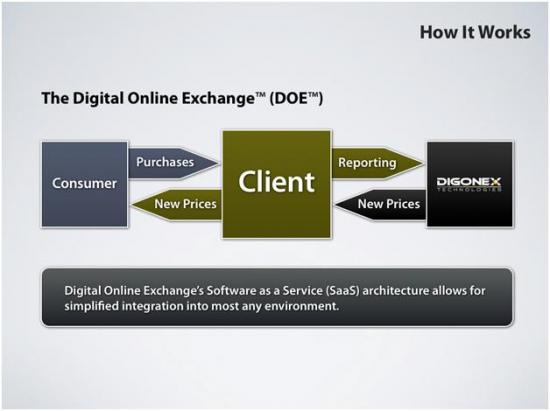
How it Works

Dynamic pricing solutions typically collect transaction data at selected intervals then aggregates and analyzes that data based on customizable criteria. Upon completion of analysis optimal product pricing is delivered for the product catalog. These pricing updates can happen automatically, keeping the product prices in synch with current demand on a day-to-day or even hour-by-hour basis. It is always important to set the business parameters within which a dynamic pricing effort will operate. For example, setting appropriate boundaries on price variation is crucial. Wildly fluctuating prices can produce a negative customer experience and impact profitability while controlled price variation can actually improve the customer experience and stimulate sales.
Digonex Artwork.JPG

Finally, dynamic pricing models are optimal for providing a more flexible, reliable way to allow organizations to maximize revenue opportunities. A full price range, non-tiered dynamic pricing model continually delivers optimal prices inline with a company’s overall business strategy. While the virtual goods industry is experiencing remarkable growth, dynamic pricing gives organizations the ability to maximize profitability today to ensure they’re set up for success tomorrow.

Maximize the Value of Virtual Goods with Dynamic Pricing

Dynamic pricing benefits industries that have high-demand uncertainty (e.g. digital music, event ticketing, e-books and e-commerce) or offer perishable products, such as hotel rooms, airline tickets or virtual goods which have a specific shelf life. In fact, that life span can be mere days or even minutes depending on the product and consumer demand.

To understand the benefit of dynamic pricing, it’s critical to understand that the virtual economy is based solely on demand – not supply and demand. While supply may not be a constraint for a game developer there is the potential to leverage supply constraints as a strategic factor to increase demand and ultimately, profits.

For example, social gaming companies such as Zynga and Playdom will regularly offer virtual products for a limited time or in-limited supply that provide the player with a significant advantage in the online virtual game they’re playing. These products are typically sold for “points” which must be earned by completing tasks in the game or purchased for real money. Limited products typically sell out in a matter of days and when they do they are usually gone forever. Those gamers that do not obtain the limited products are left to contend with those that did. When a supply constraint is placed on a virtual product it is absolutely critical to get the price right. Price too low at any given point and the product will saturate the market or sell out within hours. Price too high and demand is reduced to a fraction of what it could optimally be.

There are several pricing challenges associated with virtual goods. Virtual marketplaces are extremely fast-paced with most products having less than a 72 hour post release window to generate the majority of their sales. The optimal price for a virtual good can fluctuate more than 100 percent over the course of that 72 hour window. The speed of virtual markets require product analysis and price adjustment in a matter of minutes, not hours, in order to achieve maximum profitability. Additionally, sales stimulation or cannibalization can have a tremendous impact on almost any virtual good. For example, the price and selection of couches can drastically affect demand for coffee tables in virtual worlds. It is also important to note that many online games have secondary markets that heavily influence demand in the primary markets.

Dynamic pricing offers several additional benefits for virtual goods organizations including:

  • Ability to use constrain supply as a tool to stimulate demand. When correctly implemented, dynamic pricing can be leveraged in conjunction with supply to accomplish a number of business goals for a virtual goods organization with significantly greater success.
  • Virtual goods companies can leverage dynamic pricing models to capitalize on limited windows of opportunity and drive significant revenue for a specific digital good such as points or coins as referenced in the Zynga example above.
  • Dynamic pricing enables virtual goods organizations to reduce sales cannibalization for particular goods and adjust prices accordingly.
  • Lastly, dynamic pricing, vis-à-vis automated price optimization tools, give revenue optimization and merchandizing teams an automated solution that can help them do their jobs better, maximizing time and resources within an organization.

Conclusion

The virtual goods industry has experienced a tremendous amount of growth over the past couple of years. As the industry continues to evolve and expand, it will be important for companies to develop sound pricing strategies including the adoption of behaviorally-based pricing tools in order to maximize revenue opportunities and ensure long term success.

Dynamic pricing provides a powerful alternative for virtual goods companies seeking a solution to effectively monetize products and maximize profits.

Any dynamic pricing solution should continuously identify the “sweet spot” where prices follow perceived market value and generate the maximum economic return. This can greatly impact purchasing and selling behaviors which, in turn, can significantly drive the future of the virtual goods industry.

Engage! Expo, taking place September 23-24 at the San Jose Convention Center, provides insight into the best practices, current trends, and effective strategies of social media and user engagement. We have 200 free expo-only passes available. This is a great chance to walk the floor and get some fantastic networking in. Grab one before they’re gone. Full show details are here at http://www.engageexpo.com/sj2009/.

I’ll be doing a talk called “Virtual Goods: The State of The Industry” to kick off the agenda to the Virtual Goods Conference. I’m looking forward to seeing everyone there!

Earlier this month, leaders from the barely two year old social gaming industry gathered in San Francisco at the Social Gaming Summit 2009. It’s hard to believe that in only two short years, Facebook launched the first social networking application platform, most of the other social networking players have followed suit, and an estimated 14,000 social games have proliferated across those platforms.

The 500+ attendees at the Social Gaming Summit included representatives from top social networks, major game developers, and a wealth of infrastructure vendors, such as Offerpal Media and Zong, who have sprung up to support this rapidly growing industry. The emphasis was largely on issues of player acquisition and retention with particular emphasis on monetization and deployment of virtual goods as a key contributor to revenue generation.

Until recently, Internet companies in the United States have lagged far behind the curve in the sale of virtual goods. By most estimates, customers spent about $1.5 billion a year on virtual goods globally in 2007. Tencent Holdings, a publicly traded Internet media company based in China, runs perhaps the largest virtual goods business in the world, with hundreds of millions in annual revenue from virtual goods in online games, social media, and other applications.

In December, Jeremy Liew of Lightspeed Venture Parters made his prediction for the consumer Internet for 2009:

“In Asia people have been paying real money for virtual goods for years. It is the primary business model for games and Internet companies in China and Korea, far more important that advertising. We’re starting to see similar behavior in the U.S., also led here by online games and social networks. On the back of the rise of social networks and games, 2009 will be the first real breakout year for this business model in the US.”

We’re only half-way through the year, and it looks like Jeremy’s prediction is already proving true. It’s estimated that the total revenue generated by companies running applications on Facebook’s platform will outstrip Facebook’s own revenue in 2009. Social gaming is leading the pack here, and rumor has it that major social gaming players, such as Zynga, are making upwards of $50 million on an annualized run rate.

Venture Capitalist Bill Gurley sees this phenomenon as the answer to the monetization problems faced by Facebook, MySpace, and other top social networks which are struggling to meet revenue expectations in the face of an increasingly difficult advertising market. He ended the article by emphasizing that Wall Street was all set to welcome this new business model.

Social Gaming Trends

Leaders from the social gaming industry revealed some important trends in social gaming during the summit:

Virtual goods work with mainstream consumers

Sebastien de Halleux, COO of Playfish, said his Pet Society game sold 20 million virtual Christmas trees and ornaments last holiday. Players paid up to $2 for each virtual item and many players spent more on virtual trees than the average person spends on a real Christmas tree. Sebastien noted that a real Christmas tree is seen only by a handful of family members and close friends, but Pet Society’s virtual Christmas trees and ornaments can be seen by hundreds of online friends. This is just one way in which online behavior is driving new trends in consumer spending.

Brands are playing a vital role in social games

John Pleasants talked about how Playdom’s Sorority Life sold $100,000 worth of virtual Volkswagen’s over a two day period. Brands have struggled to find a strong role in the traditional video game market and advertising on social networks has been plagued by poor performance. However, social games offer brands a powerful promotional and merchandising vehicle and both brands and social game developers have been quick to embrace this opportunity.

Social games have unlocked the latent value in social networks

Despite having large and fervent audiences, social networks have had a hard time monetizing their user bases. Industry experts debated whether the answer would come from traditional display advertising, integrated sponsorships, lead generation, hyper-targeting, or direct user monetization. Well, the social gaming industry are proving that “all of the above” is the right answer.

Virtual goods provide both a way to directly monetize social networking users and a way to weave advertising opportunities into the social fabric of a site or app. But no one anticipated that social games would also unlock a valuable new form of lead generation marketing. Offer platforms, such as Offerpal and Superwards, allow users to earn virtual currency by completing lead forms, and they share the revenue generated from these leads with the application developer. Anu Shukla, CEO of Offeral, cited that 30 to 40% of players will bite on offers. As social networks find ways to become part of the social gaming economy, they’ll open up new revenue channels and drive their ARPU (average revenue per user) to significantly higher levels. In an extreme case, Adam Caplan, CEO of Super Rewards, discussed a social game player who bought $30,000 of virtual goods for use in two different games.

The Future of Social Gaming

The Summit highlights the fact that the Social Gaming industry has and will continue to have phenomenal growth. In a relatively short period of time, social games have proven that selling virtual goods is a viable business model in North America and that social networking audiences can generate significant revenue. Strategy Analytics recently released a forecast projecting that microtransaction revenue will grow from $1 billion in 2008 to $17.3 billion in 2015. No doubt, social gaming will be one of the driving forces behind this growth.

What will social gaming look like when it turns 3? I can’t know for sure, but here are some thoughts:

  • Social networks will monetize by providing virtual currency. Hi5, one of the social networks that followed Facebook’s lead by offering an applications platform has also learned from Facebook’s biggest mistake—not taking a share of revenue from applications and social games that run on its network. Rather than taxing applications for inclusion on its network, Hi5 opened up its Coins virtual currency to be used by app developers. This strategy provides value across the board by giving users a single currency that is accepted throughout the social network, giving developers access to a broadly-adopted microtransaction system, and giving Hi5 a way to share in microtransaction revenue. Facebook followed suit by launching the Pay with Facebook feature last month.
  • Social games will spread to new devices. Although social gaming started within social networks, every major social game developer is bringing their content to new platforms such as the iPhone. With the introduction of in-app payments earlier this month, iPhone developers will now have the perfect microtransaction system to build their content on—iTunes. However, these games are staying close to their roots; many are based on the Facebook Connect API which allows developers to access elements of Facebook’s application platform outside of Facebook on a diverse array of devices. Facebook recently announced that it will provide Facebook Connect on Xbox Live, which means that we’ll start to see social games on video game consoles.
  • Social games will spread to niche and international social networks. Wikipedia’s list of social networking websites includes over 150 sites, and the list leaves off many large international social networks. Social games are key to monetizing social networks, and we’ll see both lightweight and more involved social games become a key part of any social network which is serious about monetizing its users.
  • Traditional game companies will continue to stand on the sidelines. What was the very first hit social game? It’ll probably sound familiar—Scrabble, well actually Scrabulous. Launched shortly after the release of the Facebook Platform, Scrabulous is a social game, based on Scrabble, that was released by two brothers who became the first lucky prospectors in the social game goldrush. Rather than recognizing their good fortune in finding a new, rapidly growing medium for their games, Hasbro quickly got to the business of shutting Scrabulous down and didn’t find time to release its own version of Scrabble on Facebook months later, after major players such as Zynga had staked their claim. None of the traditional game companies have played a significant role in social games to date, and this will likely continue until the major players, such as Electronic Arts and Activision, wake up to the opportunity and start acquiring players like Playdom and Zynga.

Social gaming will continue to evolve at a whirlwind pace, and will be one of the major drivers behind the global explosion of virtual goods revenue. If you’d like to stay up to speed on these developments, I recommend checking out the upcoming Virtual Goods Conference which is part of the Engage Expo (September 23-24, 2009 in San Jose, CA) and the Virtual Goods Summit (October 29-30, 2009 in San Francisco, CA).

Last year, my company, Viximo, released its first product in partnership with BigDates Solutions, makers of the Birthday Calendar, one of a small number of Verified Applications on Facebook. Viximo provides a complete virtual goods platform that enables social media sites, such as social networks, social networking apps, and dating sites, to launch and grow a virtual goods based business model. Virtual gifting is usually the first, and often the most important, virtual goods feature on those sites.

Pioneers of virtual gifting, especially paid virtual gifting, have faced a considerable amount of skepticism. Facebook, in particular, was criticized for gouging its users when it launched its Facebook Gifts program in February 2007, and many predicted that the program would be a dismal failure. During its first year, Facebook Gifts generated an estimated $15 million, or 10% of Facebook’s overall $150 million in revenue for 2007. And virtual gifting has become mainstream enough to be featured on the front page of major newspapers such as the Boston Globe.

Revenue from online advertising on social networks continues to erode because social networking users aren’t receptive to and can easily ignore traditional banner advertising. But virtual gifting is fundamentally different — it both adds value to and is integrated into the social fabric of online communities. That not only means that people are willing to pay for virtual gifts, it also means that brands can play a valuable role in the dialog that is native to social networks.

Who is giving virtual gifts?

The first step in creating a successful virtual gifting based business is to understand who is sending virtual gifts and why they are sending them. Virtual gifting behavior closely mirrors offline gifting behavior — it is much more a function of gender than age. Women of all ages give gifts with significantly higher frequency and for a broader set of reasons than men. Men, on the other hand, give gifts primarily for romantic purposes.

Based on the data we’ve gathered, we’ve found that in a roughly 50%/50% distribution of men and women, women are responsible for 80% of virtual giftings while men are only responsible for 20% of virtual giftings. Women send gifts with equal frequency to both men and women (40% of virtual giftings are female to female and 40% are female to male); however, men are 3x more likely to send virtual gifts to women (15% of virtual gifts are men to women and 5% are men to men). Sound familiar?

Unlike many social networking phenomenon but like real-world gifting, virtual gifting is age agnostic. We’ve found that more than half of giftings through Birthday Calendar are sent by women between the ages of 22 and 32, but that is more representative of Facebook’s audience than virtual gifting’s appeal. The Boston Globe article that I referenced earlier profiles a 62 year old women who spends over a $100 a year on virtual gifts on Dogster, the pet-oriented social network that is popular with an older demographic than Facebook’s.

Why are people giving virtual gifts?

Virtual Gifts as Greeting Cards

The $7.5 billion greeting card industry is based on the notion that relationships need to be periodically acknowledged with a token that requires a small investment of time and money. In the U.S., people send 7 billion cards annually — that’s a little over 20 cards per person for a variety of holidays and events such as Valentine’s Day, Christmas, birthdays, and graduations.

As relationships move online, it’s inevitable that these offline social gestures move online as well. In fact, these gestures are more powerful online since virtual gifts can be visible to a person’s entire social network, whereas Christmas cards are only visible to the handful of lucky friends and family that get to see your mantel during the holidays.

Willingness to pay for these types of virtual gifts is easy to understand. After all, if people are willing to spend $4.00 on a small piece of card stock with some glitter glued onto it that makes it from envelope to trash in a matter of days, then a $1.00 virtual gift is a relative bargain.

Virtual Gifts as Signals

In medieval times, the act of one monarch giving another monarch a gift was an gesture of critical importance. Distance and subterfuge had robbed written words of meaning, and gifts became an important way for one person to gauge another person’s intent.

Why are gifts such an important medium of communication? Why do people agonize over what to give and how much to spend? It’s because gifts, real and virtual, are overloaded with meaning that is difficult or impossible to communicate with words alone. Gifts signify:

  1. the wealth and taste of the giver,
  2. the amount of value that the giver sees in his or her relationship with the recipient,
  3. and the extent to which the giver understands what the recipient wants.

Today, communication is cheaper and easier than it has ever been before, and that dilutes the meaning of e-mails, instant messages, and forum posts. Virtual gifts provide a valuable way to differentiate a message from the cacophony of information that people sift through every day — they show the recipient that the sender was willing to spend time and/or money to make their signal loud and clear.

HOT or NOT pioneered virtual gifting in the dating industry by letting users send virtual roses ranging from $2 to $10 to prospective dates. In an outcome that turns traditional economic theory on its ear, the $10 virtual roses have been the most popular because they send the clearest signal to the recipient, and HOT or NOT has found that recipients of virtual gifts are four times more likely to respond than users who did not receive a gift.

Virtual Gifts as Accolades

Today, eBay is a juggernaut of the Internet economy, so it’s hard to remember the days when eBay was widely considered to be one of those fringe business ideas that existed only because of dot-com exuberance. After all, who in their right mind would send money to an absolute stranger for a product that could only be seen in blurry, amateur photographs?

In the early days of Web 1.0, “reputation” was still a purely offline concept and it wasn’t clear that technology could replace or even augment the intricate network of factors that determined whether one person could trust another. One of eBay’s critical insights was that a person’s reputation is based on the collective opinions of many individuals who have had a meaningful interaction with that person, and cannot accurately be determined by singular authority. As a result, eBay enabled its users to influence each others’ reputations and that reputation system forms the foundation of trust that drives commerce on eBay to this day.

eBay’s reputation system benefits from the fact that one user can only rate another user after they have engaged in a transaction. This is a form of scarcity that imbues eBay ratings with significant social value. Many social media sites make the mistake of implementing reputation systems that are based on user-to-user accolades that are in infinite supply. As a result, these reputation system are easy to “game” and don’t hold the same weight as eBay’s reputation system.

Virtual gifts can be used in the place of ratings as the basis for a reputation system. Since virtual gifts are scarce and often have cash value, they have significantly higher social impact. In addition, virtual gifts can be designed to further enhance the effects of the reputation system with tiered accolades (i.e., gold, silver, and bronze), limited edition accolades, and accolades that are only accessible to elite members of the community.

Virtual Gifts as Social Play

In Virtual Goods and the Community values of Facebook, Bret Terrill analyzes the top gifting applications on Facebook to determine what is important to the Facebook community and why they send gifts. The applications basically fall into two buckets: apps, such as Free Gifts, Hatching Eggs, and Growing Gifts, which use the “virtual gifts as greeting cards” model that we’ve discussed and apps, such as Bumper Sticker, Pieces of Flair, and Stickerz, that features gifts with a witty, intelligent sense of humor. This shows that people often send virtual gifts for exactly the same reason they send YouTube videos or forward joke e-mails — they want to make other people laugh.

Although virtual gifts add color to the playful banter on social networks, humorous gifts face a lot of competition from status updates, joke e-mails, YouTube videos, photos, and other ways that people “play” with each other online. As a result, willingness to pay for gifts that are purely humor gifts is pretty low.

Virtual Gifts as Reciprocation

A few months ago, I was doing a presentation on virtual goods at a social networking conference, and I asked the audience to raise their hands if they had sent or received a virtual gift. A relatively large handful of people raised their hands, and I asked one of the audience members to tell me more.

She started out by saying, “I just don’t get virtual gifts. I can’t imagine why anyone would spend money on that stuff.” She went on to explain that a friend of hers had paid $1 to send her a virtual gift on Facebook for her birthday. Although I was pretty sure I knew the answer, I asked her whether she had ever sent a virtual gift. She said, “Yeah, I sent one to my friend to thank her for the virtual gift she sent on my birthday.” Surprised, I asked, “Did you pay for it?” She responded, “Of course. I don’t want her to think I’m cheap.”

Reciprocation is an essential part of giving gifts for the both the giver and the receiver. People give gifts, in part, because they want to elicit a positive response from the recipient, and recipients tend to feel indebted to the giver until they have reciprocated in kind.

If you are building a virtual gifting business, remember that a simple “thank you” virtual gift might just be the most important gift in your inventory.

Communicating through Virtual Gifts

The act of giving a virtual gift is just another form of communication, and we know that effective communication must be powerful, relevant, loud, and clear. Virtual gifts have a variety of qualities, including content, pricing, scarcity, and customization, which determine how effective they are as a communication medium. Best practices are starting to emerge, and the following table provides some guidelines on how to structure virtual gifting for different use cases.

Content Pricing Scarcity Customization
Greeting Cards Large inventory of traditional greeting card content maybe with a unique twist Most often $1, use greeting card prices as an anchor Limited editions add value, gifts shouldn’t expire Personalization adds significant value
Signals Recipient should be able to discern price of content, so small inventory is usually the way to go Sky is the limit, how much is someone on the site willing to pay to stand out? Should expire after 2-4 weeks so that senders are encouraged to “refresh” their signal Personalization helps makes signal more relevant and, hence, more effective
Accolades Small inventory with explicit or implicit meaning tied to each item (i.e., bronze, silver, gold) Vary based on level of accolade, must be cheap enough to send but expensive enough to be meaningful ($0.25-$5 is a good range based on current prices) Expiration should be tied to level of accolade, cheaper ones expire faster, more expensive ones may last forever Not important, uniformity makes accolades more meaningful
Social Play Large inventory of witty gifts, in this case shopping is half the fun Willingness to pay is low so make free or price under $2 Limited editions may add value, no reason for gifts to expire Customization can add significantly to humor
Reciprocation Small inventory, there’s only so many ways to say thank you People like to reciprocate in kind, pricing should be based on prices of other gifts in the system Limited editions and expiration not likely to be important Personalization is very important; helps underscore apprecation

Cutting Through the Noise

Today, the volume of communication that individuals have to deal with on a day-to-day basis is increasing dramatically. Facebook, Twitter, dating sites, games, e-mail, SMS, and instant messages all vie for a person’s attention. In a world inundated with social media, virtual gifting provides an essential way for users to separate signal from noise and add impact to their online social gestures.

In January, Jeremy Liew at Lightspped Venture Partners estimated that Facebook was generating $15 million annually in virtual gifting revenue. Today, Jeremy posted an update to that initial analysis which suggests that Facebook is selling virtual gifts at annual run rate between about $28 million and $43 million.

Based on the January estimate, Facebook earned an estimated $15 million in virtual gifting revenue on total estimated revenues of $150 million. Facebook is estimated to do between $300 and $350 million in revenue this year, which means that growth in virtual gifting revenue is either keeping pace with or exceeding Facebook’s overall growth.

The analysis also suggests that nearly 80% of Facebook gifts are sold from the first screen of Facebook’s gift store. This tremendous bias towards the “first page of results” will come as no surprise to search engine optimization experts and web behaviorists — the majority of people just can’t be bothered to search below the fold.

As a result of this phenomenon, the relevancy of the first page of results is absolutely crucial to whether or not a user “converts” (i.e., clicks on a search engine result on Google, buys a book on Amazon, or sends a virtual gift). While Facebook is generating a respectable amount of revenue from virtual gifting (revenue most other social networks are leaving on the table), the full potential of their virtual gifting business won’t be unlocked until they follow the merchandising best practices of successful e-commerce sites such as a Amazon.

What’s the first step? Get rid of that one size fits all storefront and use some of the Facebook Beacon targeting goodness to create personalized storefronts for Facebook Gifts shoppers.

Andrew Chen has a great post on his blog titled Virtual goods: Who will be the Amazon.com of virtual item sales?. He discusses the fact that the virtual goods industry needs a single, standardized e-commerce platform that provides virtual goods retailers with:

  • Product recommendations
  • Price testing
  • Product bundling
  • Search, browse, and navigational hierarchy
  • Reviews, ratings, lists, and metadata
  • Affiliate programs
  • Ad targeting

As virtual goods becomes an increasingly important revenue channel for social networks, social networking applications, virtual worlds, and MMOG’s, the need for a powerful virtual goods e-commerce platform will get more and more acute.

Yesterday, Forbes released an article called A Cupcake On Your iPhone that talks about Viximo’s virtual goods platform and some of our iPhone initiatives. The article has a great quote that sums up our platform business:

For Web publishers, Viximo offers a soup-to-nuts virtual gifting service that provides digital content from its community of independent developers, billing via Paypal, a revenue-share program with artists and their sites, and analytical tools that track what goods sell well. The aim, says Frasca, is to create a platform for digital goods across multiple publishers, including mobile

The article also discusses our iPhone strategy which is one of the reasons I’ve been so short on blog posts lately. If you interested in learning more about Viximo’s virtual gifting platform or talking about the virtual goods space in general, give me a shout!

VentureBeat has a great article today that discusses how virtual goods are starting to pan out for Facebook game application developers.

According to the article, popular Facebook application (fluff)friends is making an estimated $1.00 per month per daily active user and Mob Wars is making an estimated $2.60 per month per daily active user. At those levels, (fluff)friends is expected to make $1.3 million annually on a base of 112,229 daily active users and Mob Wars is expected to make $15 million on a base of 483,824 daily active users.

All of this is very encouraging in light of the fact that the value of Facebook ads continues to fall. Advertising on Facebook applications is valued at between 7.5 cents and 50 cents per thousand ad impressions (CPM). Each daily active user would need to generate thousands to tens of thousands of advertising impressions per month in order to generate revenue on the same level as virtual goods based businesses.

We’ve seen the same thing since we launched Viximo’s virtual gifting system on the Birthday Calendar application on Facebook. In order to compare virtual gifting with social network advertising, we look at total virtual gifting revenue divided by impressions of the virtual gifting offering. This gives us a metric which is roughly comparable to CPM. To date, we’ve been generating an equivalent CPM with virtual gifting that is about 10 times higher than the typical CPM for social network advertising.

Its been a long time since I posted to the blog. Launching our product, growing Viximo, and lots of summer activities have conspired against me. My goal is to get shorter posts up on the blog at least once a week. Wish me luck, and please stay tuned!

Things have been a little crazy on the Viximo front, and the Virtual Worlds 2008 Conference Series which I nobly planned to finish a week after the conference still has a couple of posts left.

This article is inspired by Virtual Goods and Branded Virtual Goods: The New Way to Revenue, a session in the Marketing and Entertainment track of Virtual Worlds 2008. The panel was moderated by Giff Constable, COO of Electric Sheep Company and featured Craig Sherman, CEO of Gaia Online; Matt Bostwick, CEO of A4R4 Media and formerly head of MTV’s Virtual Worlds group; Ruben Steiger, CEO of Millions of Us; and Gene Yoon, VP of Business Affairs of Linden Lab.

A New Era for Branding

Let’s face it. Brand marketers have had a tough few years. The mass exodus from offline media viewership to online media viewership has left many brand marketers scratching their heads. While call-to-action marketers have basked in the measurability and effectiveness of pay-per-click and pay-per-action search advertising, brand marketers are reeling from a one-two punch of decreased TV ad viewership (courtesy of TiVo) and the increased ubiquity of the lowly banner ad.

But a new era for branding is dawning—one that will make the gains of search advertising look paltry by comparison. Matt Bostwick explained that “branding” is what happens when a consumer takes a marketing message and makes it part of her mind, heart, and lifestyle. In the past, a key tool for transforming “marketing message” to “brand relationship” was poignant television advertising (just try watching a great Nike ad without having an emotional reaction). Certainly, online video will be an important vehicle for brand marketers, but the ultimate tool in the age of the avatar generation is branded virtual goods.

Branded virtual goods spark the cycle of brand engagement. The cycle begins when a viewer sees the brand in the low-barrier context of a virtual world. When a user chooses to interact with that brand, the relationship begins. As that relationship matures, the user becomes an online advocate for the brand and shares it with her social network. Return on investment is achieved in two stages: 1) when the user buys a virtual representation of the brand online and 2) when that relationship moves offline and the user buys physical branded product.

Is this really working? Absolutely. Over 80% of the MTV Virtual Worlds community have purchased a branded virtual good and these virtual goods have been used over 5 million times. Altogether, that has resulted in 50 million viral endorsements—not 50 million “impressions”, but 50 million endorsements made from one user to another. And MTV has found that people who purchased and used branded virtual goods have a radically increased interest in purchasing that brand’s physical goods.

The Vanishing Line Between Real and “Virtual”

So why is all this working? Why are people carrying online brand relationships into the real-world and vice versa? It all has to do with the avatarization of our identities. The “avatar generation” is the first generation where nearly everyone will have an avatar, where the line between people’s digital lives and offline lives will become vanishingly thin.

Parents of children who use Webkinz are all too familiar with this phenonmenon—they know that the physical plush toy is almost incidental to its online manifestation. This phenomenon is amplified by the fact that people tend to play “as themselves” in online worlds. Since avatars represent their creators, the products consumed by avatars and within virtual worlds represent real world purchase intent. Stardoll leverages this by coordinating virtual goods product availability with real world product availability. If a girl likes the way her avatar looks in that new DKNY pencil skirt, she can run out and buy it from the brick-and-mortar store that day.

Some people worry that branding sullies the virtual world experience—that people don’t want brands in their virtual worlds. Certainly, some worlds represent an online “utopia” for their users and these users want to escape the trappings of the real world. To some extent, that is why brands have had a hard time in Second Life. But, for many people, brands are a valuable mechanism for self-expression. The virtual worlds that attract users who express themselves through the clothes they wear, the bands they listen to, and the brands they use will find that branded virtual goods enhance the experience and make the virtual world more real.

A Choice-Based Medium

The most salient characteristic of branding in virtual worlds is that virtual worlds are a choice-based medium. If consumers choose your brand, that becomes a powerful viral distribution mechanism, but if consumer’s don’t choose your brand, it dies on the vine. Matt Bostwick describes this as a swarm of “brand bots”. Brand marketers send these automatons into an array of virtual worlds. In some worlds, these brand bots multiply and evolve as user’s shepherd them through the social fabric of the world, and in other worlds they go neglected and die. Many factors determine the fate of these brand bots including the nature of the virtual world, the receptivity of that world’s audience, and the resonance of the brand message. Its up to brand marketers to chose the right worlds for their brands, find the most receptive target demographic, and craft a winning brand experience.

Marketing Strategy for Virtual Goods

There is a tendency to think of virtual goods campaigns as a form of advertising or media buy. In general, media buys are fire-and-forget, but virtual goods campaigns are very different. The “build it and they will come” strategy just doesn’t work, and early players figured that out quickly. Kicking off a virtual goods campaign needs to be thought of like any other product launch—its the beginning, not the end. Just as a solid marketing strategy is necessary to win with a product launch, it is the bedrock of a successful virtual goods campaign.

“Interactive” Product Placement

As television advertising viewership has evaporated, brand marketers have found an oasis in product placement. While many forms of traditional advertising are declining, PQMedia, a consultancy focused on alternate forms of advertising, predicts that product placement spending will rise from $3.1B in 2006 to $5.6B in 2010.

In many ways, virtual goods campaigns are really a form of product placement woven into the dynamics of virtual worlds. What’s the key differentiator between traditional product placement and virtual goods campaigns? Interactivity.

Since virtual worlds are a choice-based medium, product placement in virtual worlds is subject to the swarm effect I discussed earlier—the products are given over to consumers, instead of television producers, to place, position, and promote.

The tactics that make a successful product placement campaign work in virtual worlds too:

  • Carefully select the contexts in which your product appears—the contexts should be relevant and complementary
  • Products should be identifiably, but subtly, branded—big and loud logos are too heavy handed
  • Know that you are giving up some control and be aware of the risks and rewards
  • Make it easy for the consumer to take action (e.g., TV placements are often followed by informational ad spots to help close the sale, Stardoll makes it easy to buy the clothes featured online, etc.)

One of the tactics that is unique to virtual worlds is that virtual goods can reinforce brand messages through the mechanics of that virtual world. Craig Sherman from Gaia Online discussed how Nike is integrated into their world. A key brand message for Nike is that they help you achieve better athletic performance. How do you reinforce that in a virtual world? Well, when a consumer buys a pair of Nikes in Gaia Online, they enable that person’s avatar to run faster. As with real-world product placement, virtual goods campaigns aren’t just about slapping a logo on a visual asset.

Theatrical Experiences

gaia_wwe.jpg

Craig Sherman and Ruben Steiger discussed the strategy for integrating brands and branded virtual goods into Gaia Online. The true power of the virtual world medium is unleashed when operators and brands work together to create theatrical experiences that permeate every facet of the virtual world. Certainly, one of the masters of offline theatrical experiences is the WWE. Ruben discussed how Millions of Us, Gaia Online, and the WWE worked together to pull that theatrical flair into Gaia.

They started the campaign with an event in Gaia’s forums. John Cena, one of the WWE’s main protagonists, was an active participant in the forum. Like fans at an offline WWE event, various people started heckling John in the forums. When the forums got to a heated pitch, one of the Gaia users was revealed as John’s nemesis and that kicked off the rivalry at WWE SummerSlam. The campaign was a major success (it has been honored with a couple rewards) and virtual goods related to the WWE became highly sought after in the Gaia community.

Ruben explained that virtual goods allow brand marketers to explore entirely new areas. Virtual goods can act as the medium for stories or brand messages, can evolve over time, can unlock capabilities such as being able to run faster, and can make users an integral part of the brand story.

Channel Strategy

Channel strategy is one of the four pillars of traditional marketing strategy. It turns out that channel strategy is just as important for virtual goods campaigns.

The first step in defining a successful channel strategy is to select the appropriate online services and virtual worlds for a given brand. As with offline channel strategy, one of the callenges of an online channel strategy is dealing with lack of control if the channel is not owned and operated by the brand. Many brands are addressing this challenge by developing their own virtual worlds. For example, Mattel built its own channel for its Barbie brand with Barbie Girls and Disney is planning to invest up to $100 million in 10 different virtual worlds for its brands.

As in the real world, it’s not always optimal or practical for product brands to vertically integrate into distribution. This will become increasingly true as virtual world development costs follow the same path as video game development costs (it currently costs about $5 million to implement a basic virtual world and this cost will increase to $20-$50 million over the next 5-7 years). Matt Bostwick hit the point when he said: “You don’t need to build New York City in order to sell Coke.” Even in the cases where a brand decides to implement its own virtual worlds, valuable opportunities are missed if that brand focuses exclusively on those worlds.

second_life_loreal.jpg

Once a brand has selected the appropriate virtual worlds for its products, then it needs to devise a distribution strategy for reaching consumers in those worlds. Oftentimes, the operator of the virtual world will be instrumental in defining that distribution strategy. However, in more free-form worlds such as Second Life, the brand may need to implement its own promotion and distribution plan.

Brands would be wise to follow the example of the L’Oreal campaign in Second Life which was run by K Zero. Typically, when brands have implemented campaigns in Second Life, they create their own venue and attempt to drive traffic to that venue (this is the analog of a brand running its own brick-and-mortar retail store). Instead, K Zero and L’Oreal worked with successful virtual entrepreneurs to promote and distribute L’Oreal’s virtual products through their existing distribution networks. What L’Oreal lost in “brand control”, they more than made up for in increased awareness and distribution.

The best practices for channel strategy carry over into the online world: success is achieved by selecting a mix of appropriate channels and by carefully managing, motivating, and monitoring those channels. Channel decisions are never easy, but the right ones separate success from failure.

Just the Beginning

We really are at the dawn of a new era for brands. Opportunities abound, but so do risks. Brands will have to navigate a permanent shift to increased consumer choice and control. The music industry faced a similar inflection point a few years ago. Consumer brands are already proving that they are much more savvy than the big record labels, and they’ll reap the corresponding rewards.

About

Virtual Goods Insider covers the burgeoning economy of in-game items, avatar customization, virtual gifts, digital media, and other goods that exist purely in digital form. It is written and published by Ravi Mehta, a veteran of the online gaming and consumer media industries.

Categories